Michelle Stine Script: A Handcrafted Touch for Real Products
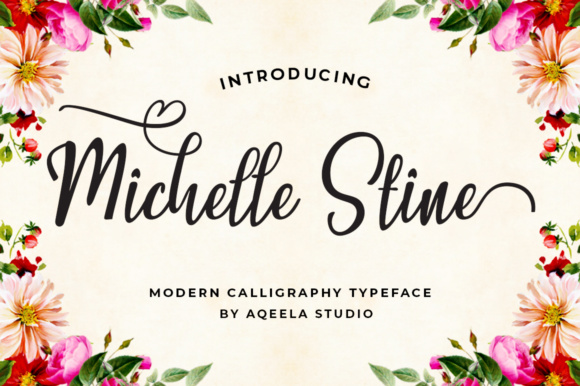
If you’ve ever held a beautifully labeled candle, admired a wedding welcome board with effortless elegance, or paused over a boutique tag that felt *just right*, you know how much a font can quietly shape perception. Michelle Stine Script isn’t just another script font—it’s the kind of modern calligraphy typeface that moves with intention. Its letters dance along the baseline, not in chaotic loops, but with rhythmic grace—soft curves, subtle contrast, and a gentle lift that feels both personal and polished. As someone who prints labels on my Epson, cuts vinyl for mugs on my Cricut, and designs printable planner pages sold to thousands of Etsy buyers, I reach for Michelle Stine Script when I need warmth *and* wearability.
This is a display font built for real-world making. It shines brightest at medium to large sizes—think 24pt and up on greeting cards, 48pt+ on farmhouse signs, or even 16–20pt on high-res product tags where fine details hold. Because its strokes flow naturally—not tightly connected like traditional copperplate—it stays legible even when cut small on 1-inch stickers or embroidered onto linen tea towels. I’ve used it for “Hand-Poured” on soy wax candle jars (paired with a crisp sans serif for ingredients), and for “Est. 2022” on vintage-style shop signage—always clean, never fussy.
Michelle Stine Script works especially well for emotional moments and intentional branding. Wedding invitations? Yes—but not just for “Mr. & Mrs.” It carries weight in monogrammed napkin wraps, delicate foil-stamped place cards, and digital RSVP templates where readability matters under soft lighting. Baby shower printables? Try it for “Welcome Little One” above watercolor florals. Holiday packaging? Use it for “Made with Love” on kraft gift boxes—its elegance lifts humble materials without looking out of place.
For physical product makers, pairing is non-negotiable—and Michelle Stine Script pairs beautifully with grounded, functional fonts. I default to a clean, open sans serif (like Montserrat or Poppins) for body text, ingredient lists, care instructions, or QR code labels. The contrast lets Michelle Stine Script breathe as a focal point while keeping information scannable. On SVG files for Silhouette users, I often layer it over subtle serif headers (think Playfair Display) for boutique-style wall art—elegant but never fragile. And because it’s part of the Script Amp collection, it’s designed with crafters in mind: OpenType features include stylistic alternates and optional swashes, so you can soften “&” or add a graceful exit stroke to “y” or “g” without switching fonts.
Readability in production is where many beautiful scripts fall short. Michelle Stine Script avoids that trap. Its x-height is generous, letter spacing is forgiving, and terminals are clear—not overly tapered—so it cuts cleanly on vinyl, holds detail in screen-printed tote bags, and renders crisply in PDF printables. When prepping files for print-on-demand planners, I test at 12pt in mockups: names and titles stay distinct, and customers rarely ask, “What does this say?” That reliability saves time and builds trust—especially when your brand lives across stickers, shirts, and social media graphics.
I use Michelle Stine Script across categories with confidence: for handwritten-style product names on apothecary labels (lavender + rosemary soap bars), as the hero font in Canva templates for small business owners, on chalkboard-style menu boards for coffee shops, and even subtly embossed on cotton gift tags. It adapts—never overwhelms. Unlike ultra-thin scripts that vanish on textured paper, Michelle Stine Script has enough presence to anchor a design without shouting. And because it’s a premium font built for commercial use, the license covers everything I do: selling physical goods, digital downloads, editable Canva templates, SVG bundles for cutting machines, and client work for local boutiques.
File-wise, it comes in standard OTF and TTF formats—no fuss for Cricut Design Space, Silhouette Studio, Adobe Creative Cloud, or free tools like Inkscape. No extra plugins needed. No missing glyphs. It supports basic Latin multilingual characters (including accented letters common in French, Spanish, and German), which matters if you’re designing bilingual baby announcements or sourcing international stockists. And while it’s not meant for full paragraphs, it handles short phrases with ease: “Small Batch,” “Grown Here,” “Brewed Daily,” “Hand-Tied.” Each feels intentional—not decorative filler.
What sets Michelle Stine Script apart isn’t just how it looks—it’s how it *performs*. In a crowded marketplace where handmade goods compete on feeling as much as function, this font helps your product say, “I was made with care”—not just in the making, but in the messaging. It adds quiet sophistication to a $5 sticker and timeless warmth to a $250 wedding suite. Whether you're laser-cutting wooden coasters, printing botanical tea labels, or building a cohesive brand identity across Instagram, packaging, and email headers, Michelle Stine Script delivers consistent tone without demanding constant tweaking.
It’s become my go-to for projects where elegance must meet execution—where beauty doesn’t sacrifice clarity, and charm doesn’t compromise commercial practicality. If you’re choosing fonts for products people hold, display, gift, or live with daily, Michelle Stine Script earns its place not as an accent, but as a trusted collaborator.