Angel Heart Script: A Designer’s Real-World Review
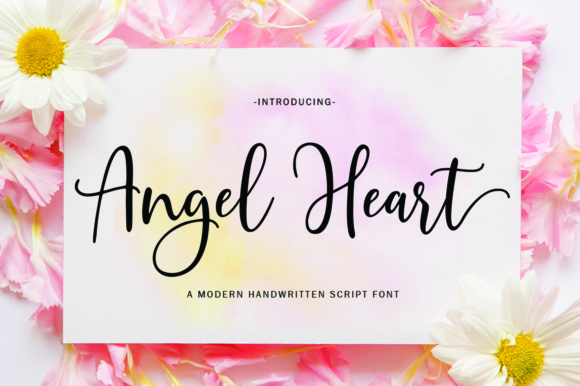
First impression? Angel Heart Script doesn’t whisper — it leans in with quiet confidence. It’s not the kind of script font that shouts “romance” or “whimsy” with overdone flourishes. Instead, it carries a gentle elegance: soft entry strokes, subtle contrast between thick and thin, and a natural, unhurried rhythm across lowercase letters. The terminals taper cleanly; the loops feel intentional, not automatic. This is a script font built for breathing room — not chaos. It lands somewhere between modern typography and timeless refinement, making it instantly legible yet unmistakably personal.
Where Angel Heart Script Earns Its Place
In logo design, Angel Heart Script shines when the brand voice values sincerity over spectacle — think artisanal skincare, boutique stationery, slow-fashion labels, or mindful wellness studios. It works beautifully as a primary wordmark for names under four words, especially when paired with a clean sans serif for taglines or supporting text. I’ve used it successfully in packaging design for small-batch candles and ceramic studios — its warmth translates directly to tactile materials like kraft paper and matte laminates.
For invitations and wedding stationery, Angel Heart Script delivers emotional resonance without cliché. Unlike many handwritten font alternatives, it avoids looking traced or overly digitized. Its consistent baseline and balanced spacing mean it holds up in tight layouts — no awkward letter collisions in monogram treatments or RSVP lines.
In social media graphics and digital ads, Angel Heart Script performs best at medium to large sizes (36pt+ on screen). It adds visual distinction to quote cards, blog headers, and Instagram story highlights — particularly when layered over soft gradients or neutral photography. As a display font, it’s not meant for body copy, but it excels as a focal point: a single line of text that invites pause, not skimming.
I’ve also embedded Angel Heart Script into Canva templates for creative entrepreneurs and used it in Cricut-ready SVG files for printable design — it scales cleanly down to 18pt for small product labels and up to 120pt for wall art. Its outlines remain crisp, even when converted to vector paths or exported as PNGs with transparency.
Where to Use It With Intention — Not Assumption
Angel Heart Script is not a universal solution. It’s not ideal for long headlines with complex punctuation, all-caps settings (the uppercase forms are elegant but lose some of the lowercase’s organic flow), or interfaces requiring rapid scanning — like app navigation or e-commerce banners where clarity trumps charm.
It thrives in short bursts: brand marks, signature lines, pull quotes in editorial design, decorative accents on greeting cards, and premium packaging where perceived value matters. Think “Hand-poured • Small Batch • Made in Portland” — not “Terms & Conditions Apply.”
On websites, use it sparingly: hero section headlines, testimonial signatures, or section dividers. Never as navigation or button text. In print, test it on real mockups — especially with textured papers — because its delicate thins can disappear on uncoated stock if not sized thoughtfully.
Readability, Trust, and the Unspoken Language of Type
Readability isn’t just about legibility — it’s about how quickly a viewer grasps tone and intent. Angel Heart Script communicates care and craft before a single word is read. That builds audience trust for brands rooted in authenticity. But misuse undermines that: cramming it into tight columns, pairing it with clashing fonts, or stretching it unnaturally breaks the illusion of human touch.
Brand consistency suffers when designers treat Angel Heart Script as a “pretty add-on” rather than a deliberate voice. If your core identity relies on bold, geometric sans serifs, dropping in Angel Heart Script for one Instagram post creates visual dissonance — not cohesion. Use it where it reinforces, not contradicts, your established hierarchy and mood.
Engagement rises when Angel Heart Script appears where attention is already slowing down: blog intros, email subject lines (as image text), printed thank-you notes, or limited-edition product drops. It signals “this moment matters.”
Practical Designer Notes You’ll Actually Use
- Always test in black and white first. Angel Heart Script’s subtlety lives in contrast — color can mask weak spacing or uneven stroke weight.
- Check small-size readability early. At 12pt on packaging labels, some lowercase connections tighten. Adjust tracking manually if needed — don’t rely on auto-kerning alone.
- Compare uppercase vs. lowercase in context. The capitals have more presence but less flow. Use them selectively — initials, acronyms, or standalone words — not full sentences.
- Review spacing across real phrases. Words like “flow,” “love,” and “heart” reveal how well the ligatures and letterfit behave. Watch for awkward gaps after ‘f’ or ‘y’.
- Pair it deliberately. Try Angel Heart Script beside a warm serif font (like Playfair Display) for luxury editorial work, a neutral sans serif (like Inter or Montserrat) for modern brand identity, or a restrained handwritten font (not another script) for layered texture. Avoid pairing with other high-contrast script fonts — it creates visual competition, not harmony.
- Confirm commercial licensing before client work. Angel Heart Script is a commercial font from Script Amp — verify usage rights cover your project scope, especially for digital products, SaaS platforms, or merchandise resale. Don’t assume desktop license = web embedding.
A Final Thought From the Design Desk
Angel Heart Script isn’t flashy — and that’s its strength. In an era saturated with aggressive display fonts and algorithm-optimized type, it offers something rarer: quiet authority. It doesn’t beg for attention. It earns it — through balance, restraint, and thoughtful execution. Used with discipline, it becomes part of the brand’s quiet signature, not just decoration. That’s what makes it a reliable premium font for designers who prioritize meaning over momentum.
If you’re building brand identity, crafting packaging design, or developing digital products where tone is as critical as function, Angel Heart Script deserves a place in your working toolkit — not as a novelty, but as a considered voice.